
Nutrition for training – where to start?
Calories, protein, your plate and the scale. A simple system that works without weighing every lettuce leaf – and how my app helps with it.
The most common question I get from clients isn't about exercises – it's about food. Fair enough: training is the stimulus, but what you eat decides whether your body has what it needs to rebuild. The good news: you don't need a strict diet. You need a few rules you can keep for months.
1. Know your energy needs
The starting point is the number of calories that keeps your body weight stable. It is most often calculated with the Mifflin-St Jeor equation (1990). A systematic review by Frankenfield et al. (2005) found it to be the most accurate of the popular equations for estimating resting energy expenditure in healthy adults. Multiply the result by an activity factor and you have your total needs.
Remember: this is an estimate, not a verdict. Treat it as a starting point and adjust after 2–3 weeks.
2. Set your goal: cut, maintain or gain
- Cut – a moderate deficit, about 10–20% below your needs. Helms et al. (2014) recommend losing about 0.5–1% of body weight per week to limit muscle loss.
- Maintain – eat at your needs and focus on strength and body composition.
- Gain – a small surplus of about 5–10%. A bigger surplus usually just means more fat.
3. Protein first
A meta-analysis by Morton et al. (2018) showed that with resistance training, the benefits for muscle mass increase up to about 1.6 g of protein per kg of body weight per day. When cutting, aim a bit higher – around 1.8–2.2 g/kg – because protein protects muscle and keeps you full. The simplest rule: a portion of protein in every meal (more in my article on protein).
4. Think plate, not spreadsheet
You don't need to weigh everything. Day to day, the plate rule – also promoted by Poland's National Centre for Nutrition Education – is enough:
- half the plate – vegetables and fruit,
- a quarter – a protein source (meat, fish, eggs, dairy, tofu, legumes),
- a quarter – whole grains (groats, rice, bread, pasta),
- plus some healthy fat (olive oil, nuts, avocado) and water to drink.
Before training, have a meal with carbs and protein 2–3 hours earlier. After training – just a normal, balanced meal. No magic windows.
5. The scale tells the truth – if you use it wisely
A systematic review by Zheng et al. (2015) found that regular self-weighing is associated with better weight-management outcomes. The key: weigh yourself in the morning, before eating, a few times a week, and look at the trend, not a single number. Weight can jump 1–2 kg in a day because of water, salt or carbs.
How we do it in the Orchowski. app
So that this doesn't stay theory, I built nutrition into the app my clients use:
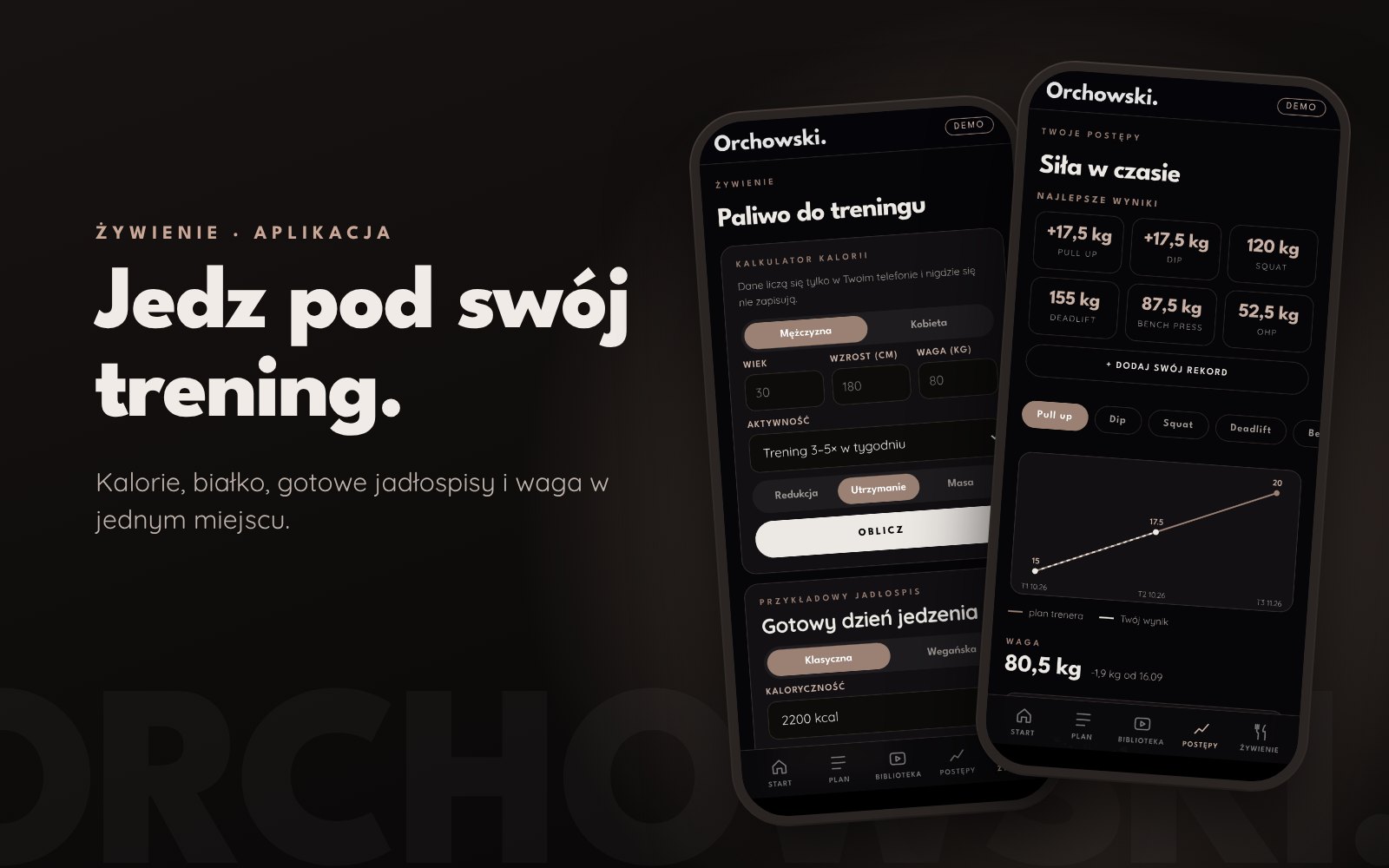
- Calorie and macro calculator – Mifflin-St Jeor, your goal (cut / maintain / gain) and a split into protein, fat and carbs. The data is calculated only on your phone and is never stored.
- Ready meal plans – classic and vegan, scaled from 1600 to 3200 kcal (in Polish).
- Body weight and chart – you log your weight (only with your consent) and the app draws the trend we review together.
- Training plan and strength progress in the same place – you see how food turns into results.
See what it looks like: open the app demo. And if you want me to guide you step by step – with a plan, the app and direct contact – check online training.
Sources
- Mifflin MD i wsp. A new predictive equation for resting energy expenditure in healthy individuals. American Journal of Clinical Nutrition, 1990. PubMed
- Frankenfield D i wsp. Comparison of predictive equations for resting metabolic rate in healthy nonobese and obese adults: a systematic review. Journal of the American Dietetic Association, 2005. PubMed
- Helms ER i wsp. Evidence-based recommendations for natural bodybuilding contest preparation: nutrition and supplementation. Journal of the International Society of Sports Nutrition, 2014. PubMed
- Morton RW i wsp. A systematic review, meta-analysis and meta-regression of the effect of protein supplementation on resistance training-induced gains in muscle mass and strength in healthy adults. British Journal of Sports Medicine, 2018. PubMed
- Zheng Y i wsp. Self-weighing in weight management: a systematic literature review. Obesity, 2015. PubMed
- Narodowe Centrum Edukacji Żywieniowej (NIZP PZH-PIB). Talerz Zdrowego Żywienia. ncez.pzh.gov.pl
This article is for educational purposes and does not replace advice from a doctor or dietitian.