Street Lifting – what is it and how to get started?
Strength with added weight on the bar and dip station. I explain what Street Lifting is, how competitions work and how to start safely.
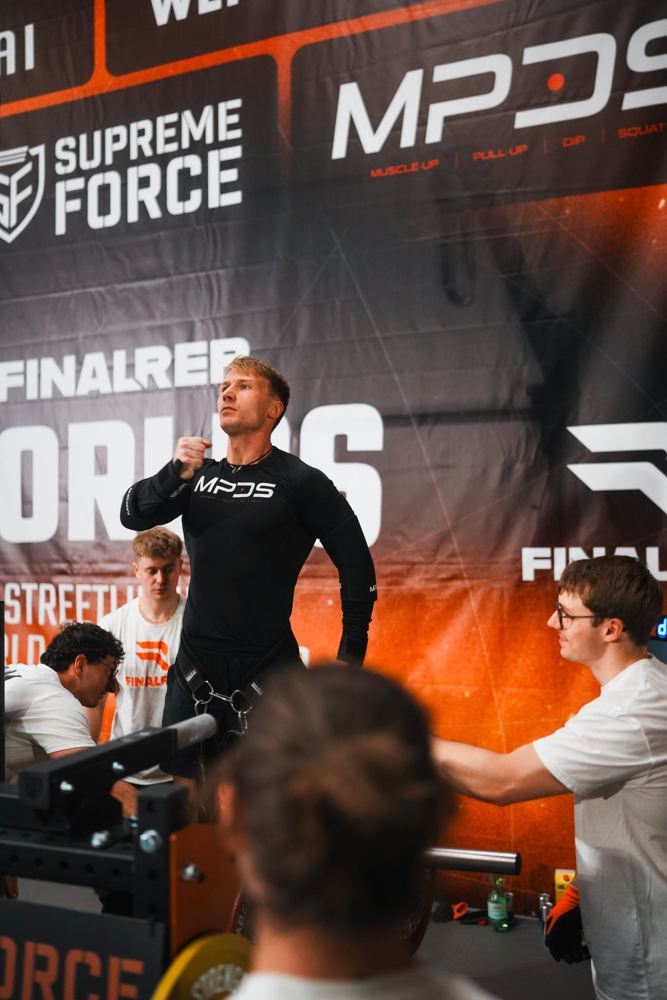
Street Lifting (also called Weighted Calisthenics) is a strength sport that grew out of street workout. Instead of counting reps or skills, we compete to complete a movement with as much added weight as possible – hung from a dip belt or carried in a vest.
What do competitions look like?
Each athlete gets several attempts per lift, and the result is the total – the sum of the best successful attempts. The set of lifts depends on the organiser. Most often you will see:
- weighted muscle-up,
- weighted pull-up,
- weighted dip,
- barbell back squat – in the four-lift format.
Athletes compete in weight classes and judges assess every attempt: full range of motion, locked elbows, chin over the bar. I compete in the -80 kg class – in Cologne in 2023 I became the first athlete ever to total over 500 kg.
How to start
1. Technique and bodyweight base first. Before adding weight, master clean pull-ups and dips through the full range. Around 10 strict pull-ups and 15 dips is a good starting point.
2. Train regularly, 2–3 times a week. A meta-analysis by Schoenfeld et al. (2016) found that training a muscle group at least twice a week produces better hypertrophy than once a week.
3. Manage intensity. Instead of training to failure, use RIR – how many reps you have “in reserve”. Zourdos et al. (2016) showed that an RIR-based RPE scale reflects actual effort well, including in experienced lifters. Finish most sets with 1–3 reps in reserve.
4. Add weight in small steps. 1.25–2.5 kg at a time is plenty. Progress you can sustain for months beats a quick jump that ends with sore elbows.
5. Look after shoulders and elbows. Warm-ups, gradual ramp-up sets and rotator cuff work are essential – especially for dips and muscle-ups.
Who is Street Lifting for?
Anyone who enjoys bodyweight training and wants to see measurable strength progress. You don't have to compete – the structure alone (specific lifts, numbers, progression) is hugely motivating.
Want to start with someone who went from zero to World Champion? See online training.
Sources
- Schoenfeld BJ, Ogborn D, Krieger JW. Effects of Resistance Training Frequency on Measures of Muscle Hypertrophy: A Systematic Review and Meta-Analysis. Sports Medicine, 2016. PubMed
- Zourdos MC i wsp. Novel Resistance Training–Specific Rating of Perceived Exertion Scale Measuring Repetitions in Reserve. Journal of Strength and Conditioning Research, 2016. PubMed
- Helms ER i wsp. Application of the Repetitions in Reserve-Based Rating of Perceived Exertion Scale for Resistance Training. Strength and Conditioning Journal, 2016. PubMed
This article is for educational purposes and does not replace advice from a doctor or dietitian.