
Before you step up – how to prepare for a competition
The last 2 weeks, the night before, your routine and your head. What the science says – and how I do it.
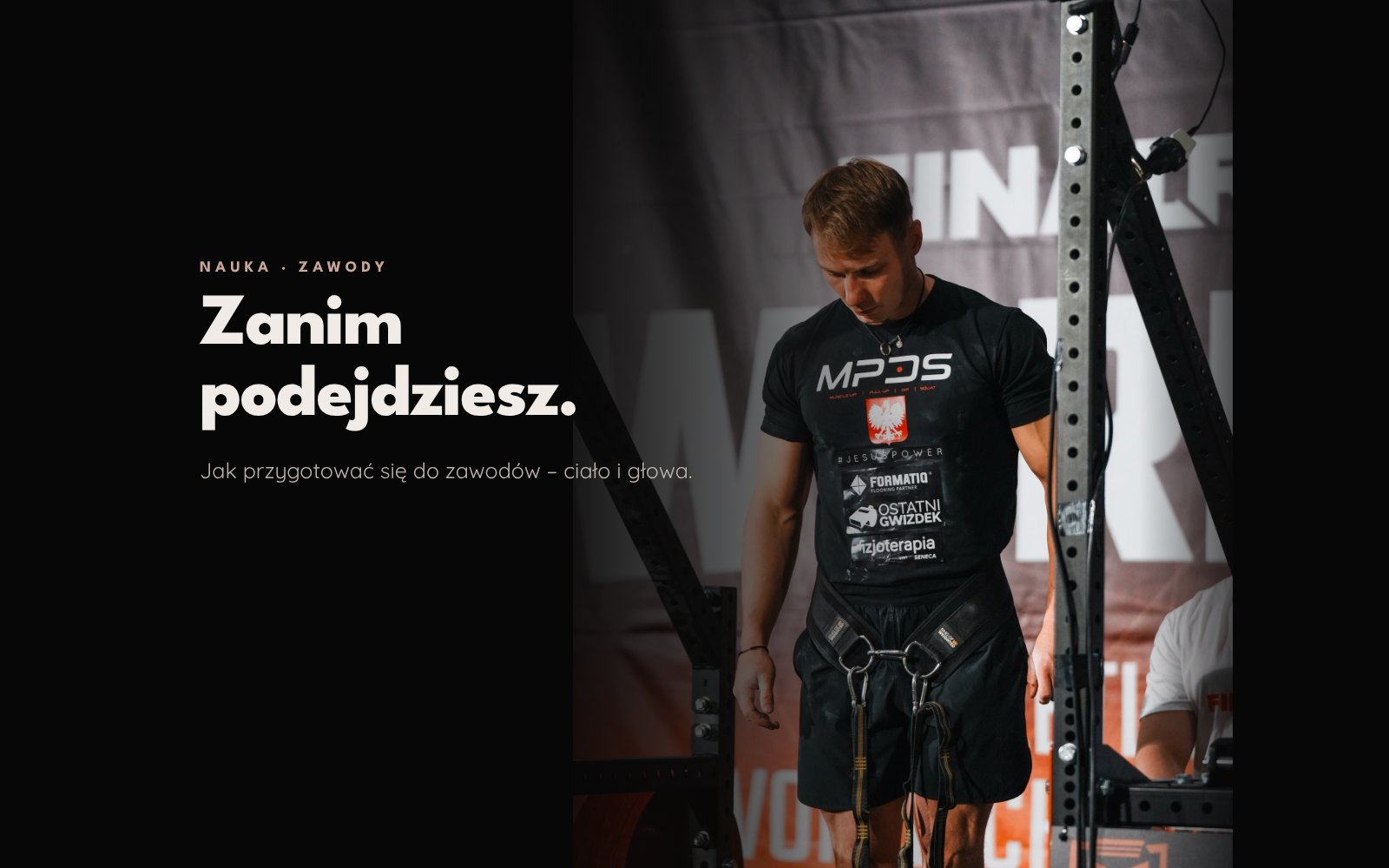
Months of training can be wasted in the last days before a competition – usually not through lack of strength, but through fatigue, nerves or overthinking on the platform. Here is what research says about competition day – and what I do.
1. The last 2 weeks: less is more
A meta-analysis of 27 studies by Bosquet et al. (2007) found the best results with a taper of about 2 weeks, in which training volume is gradually reduced by 41–60% while intensity and frequency stay the same. Fatigue drops, strength stays.
In practice: fewer sets, but the weights stay serious. This is not the time for gym PRs or new exercises.
2. The night before – relax
In a study by Juliff, Halson and Peiffer (2015), 64% of elite athletes reported sleeping worse at least once before an important competition. The main problem was falling asleep, and the reason – thoughts about the competition and nerves.
That's normal and doesn't ruin your result. Sleep across the whole week matters more than one night. Keep regular sleep hours in the final days and don't fight the clock the night before.
3. A consistent pre-performance routine
Rupprecht, Tran and Gröpel (2021) meta-analysed data from 15 sports and 800 athletes. A consistent routine before performing improved results – in the lab and in competition, with and without pressure, regardless of age, gender or level.
It doesn't need to be complicated. It needs to be the same every time: the same warm-up, the same attempts, the same moment of calm before you step up.
4. My routine: a conversation with God
For me, the most important moment before a start is prayer. I talk with God and we go through everything step by step: stepping onto the platform, the grip, every rep. I hand over what I can't control.
It is first of all my faith. But going through every movement in your head is also what sport psychology calls imagery – and a meta-analysis by Simonsmeier et al. (2021) confirms that it improves sport performance.
5. On the platform: stop thinking
When I step up, I don't analyse anything anymore. It's all been talked through. Research by Beilock and Carr (2001) showed that skilled performers who start consciously controlling every detail of a well-learned movement under pressure often perform worse. A movement you've done thousands of times works best when you don't get in its way.
Your competition plan
- 2 weeks out: less volume, same intensity.
- All week: regular sleep – not just the night before.
- Competition day: nothing new – food, gear and warm-up as in training.
- Before each attempt: the same routine, every time, and a run-through in your head.
- On the platform: trust your training and let go of thinking.
I prepare athletes for StreetLifting competitions and more – we plan the training, the taper and the competition-day strategy together. Check online training or get in touch.
Sources
- Bosquet L i wsp. Effects of tapering on performance: a meta-analysis. Medicine & Science in Sports & Exercise, 2007. PubMed
- Juliff LE, Halson SL, Peiffer JJ. Understanding sleep disturbance in athletes prior to important competitions. Journal of Science and Medicine in Sport, 2015. PubMed
- Rupprecht AGO, Tran US, Gröpel P. The effectiveness of pre-performance routines in sports: a meta-analysis. International Review of Sport and Exercise Psychology, 2021. doi.org/10.1080/1750984X.2021.1944271
- Simonsmeier BA i wsp. The effects of imagery interventions in sports: a meta-analysis. International Review of Sport and Exercise Psychology, 2021.
- Beilock SL, Carr TH. On the fragility of skilled performance: what governs choking under pressure? Journal of Experimental Psychology: General, 2001. PubMed
This article is for educational purposes and does not replace advice from a doctor or dietitian.